


The frustrating thing about a slow phone is that it doesn’t tell you why it’s slow.
When businesses want more customers, the instinct is often to chase more leads or buy another advertising product. But that’s not always where the problem is.
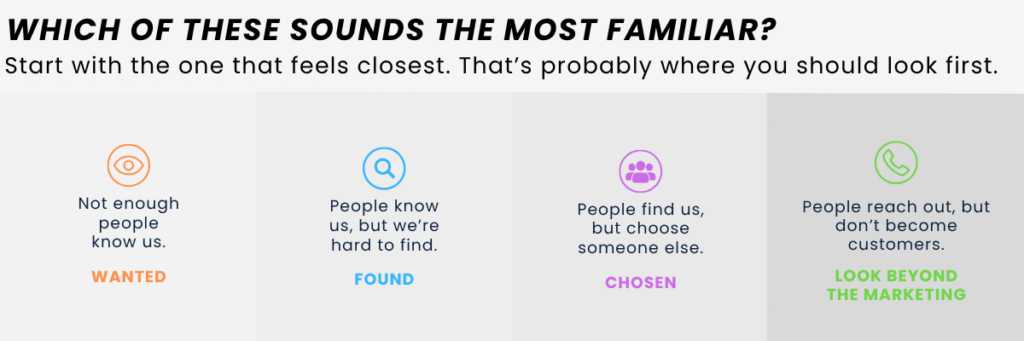
Sometimes not enough people know you exist. Sometimes they know you but can’t find you when they’re ready to buy. Sometimes they find you and choose someone else. And sometimes the marketing works! They reach out… but something breaks down afterward.
We see all four. And they don’t have the same fix. That’s why “we need more leads” isn’t a very useful diagnosis.
01. Not enough people know you.
Here’s the problem with figuring out whether enough people know your business: everyone you can see already does. The people who call, visit your website, search your name or walk through your door have already found their way into your world. The people who don’t know you? They’re mostly invisible.
That makes awareness a bit of a ghost metric. Branded searches, direct traffic, website visits and calls can show movement, but they can’t count the potential customers who simply never thought of you in the first place.
So a quiet phone doesn’t automatically mean you need more leads. You may need more people to know you before they need you. That’s the job of awareness advertising: earning a place in someone’s head before the need shows up.
02. People know you, but you’re hard to find.
There’s a pretty easy way to convince yourself your business is easy to find: search for it by name. Of course you’ll find it. You already know exactly what you’re looking for. Your customers don’t always have that advantage. (And while you’re there, don’t be surprised if you spot a competitor or two advertising on your name.)
Now take your business name out of the search. Search the service, category or problem that should reasonably lead someone to you and pay attention to what shows up instead.
This is where visibility problems can hide in plain sight. A business can have a website, a verified Google Business Profile, years of history in the market, and still be surprisingly difficult to find when someone searches without its name. If your Google Business Profile is part of the problem, start there. This 7 Google Business Profile Mistakes—and How to Fix Them guide walks through the basics worth checking before you spend money trying to drive more people to it.
Look at the results the way a potential customer would. Can they quickly tell what you do, where you do it and whether you’re a reasonable option? What do they see from your competitors before they ever get to you? Finding yourself isn’t the test. Being found by someone who wasn’t already looking for you is.
03. People find you but choose someone else.
Being found gets you into the decision, but it doesn’t mean you’re going to win it. The tricky part is that you know things about your business your customers don’t. You know the quality of the work, the experience behind it and what your team does differently. Someone considering you for the first time only knows what they can see.
Look at your business from that side of the decision, then do the same with two or three competitors. What evidence does a potential customer actually have to work with? Reviews, photos, your website, examples of your work, answers to their questions and the reputation they find online all help them decide whether the business you know is the business they see.
That’s why a decision problem can easily get mistaken for a traffic problem. People may already be finding you; they just may not have enough reason—or enough confidence—to choose you.
If I didn’t already know how good we are, would I still choose us?
If the answer gives you pause, more traffic may not be the first thing you need. Make sure the reasons to choose you are visible to someone who doesn’t already know them.
04. People reach out, but don’t become customers.
IIf people are calling, submitting forms or sending messages, you already have opportunities coming in. What happens to those opportunities next is a different question. If too few inquiries become customers, adding more leads may only put more people into a process that’s already losing them.
This is another one you can test yourself. Call your business or submit a form and see what happens from the customer’s side. How quickly does someone respond? Is the response useful? Is the next step clear? Then follow the inquiry beyond that first interaction. A lead that received a response isn’t necessarily a lead that received good follow-up.
If the opportunities are already coming in, look at response time, follow-up and the sales process before assuming marketing needs to generate more of them. Before you pay for more leads, make sure you’re not losing the ones you already have.
So, why is the phone still quiet?
By now, you probably have a better idea of where to look. Maybe more people need to know you. Maybe you’re harder to find than you thought. Maybe customers are finding you but don’t have enough reason to choose you. Or maybe the opportunities are already coming in and something is getting lost afterward.
You don’t need to figure out everything that’s happening in your marketing in ten minutes. You just need to get closer to the real problem than “we need more leads.”
Figure out the problem before you pay to solve it.
Complimentary consultation
A real strategist, your market, about 20 minutes.
No obligation. We never sell or share your information.